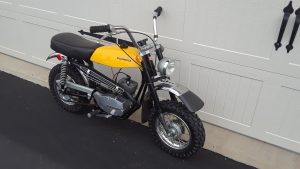
The Real can-am minibike!
In addition to Garelli mini-bike, can-am developed its own mini-bike which never made it into production.
Set out below is the real story of the can-am mini bike, directly from Dave McLean, the original development engineer for can-am. This is a first hand account of the Bombardier designed Agrati-Garelli mini-bike, as Dave was the technician who assembled all the parts and did the initial evaluation.
The Bombardier motorcycle research and development operations started at the beginning of 1971. The purpose was to develop a quality designed street/trail, motocross, enduro motorcycle. The chassis,for the most part, was designed in Valcourt, Quebec, Canada and the engine, for the most part, was designed by Rotax in Gunskirchen, Austria. However, there was one additional project added on. Bombardier had a multi year contract with Agrati-Garelli in Italy. In previous years, three 50cc trail-oriented motorcycles were imported as Bombardier motorcycles. None of these motorcycles were sized as a true, simple mini-bike for youngsters. In 1971, mini-bikes that could easily be transported to a riding area in the trunk of a large American car were popular and selling well. In the 1960’s the very simple American made mini-bike gained popularity and by the late 1960’s the Japanese entered this market successfully. It was decided to broaden the line of Agrati-Garelli imported motorcycles. Unfortunately, they did not produce a simple mini-bike like this. The decision was made to design a mini-bike in Valcourt, using parts that were already being produced by Agrati-Garelli or if not by them, already produced in Italy for other manufacturers. Lastly, new tooling was to be kept minimal to keep costs down. The basis for this mini-bike was the Agrati-Garelli moped, a 50cc two-stroke, two speed, fully automatic. No need for a youngster to learn about clutch engagement and gear shifting.
The pedal assembly was removed from the engine and plugs were installed. The primary drive outer case was redesigned to accept a kick start mechanism (new tooling). The frame tubes were reduced in length to provide a frame size that was small enough for a 5 year old and large enough for a parent to ride without having their legs caught up with the handle bars. The high mounted exhaust system consisted of an expansion chamber, muffler and spark arrester. The head pipe required (new tooling). The wheels were both spoked 10 inch, with 3.00 inch semi, knobby tires. The fenders were both chromed steel with a new front fender mount (new tooling). The front and rear suspension was by coil spring with no oil damping or lubrication. The front fork offset relative to the steering stem was reduced (new tooling) to provide more front tire contact trail (a dirt bike is likely to meet deep dirt, which requires more trail for straight line stability). The handle bars were secured by a fine thread knob on top of the steering stem and located by a dowel pin. To allow the bike to be transported while lying on its right-hand side, there is a second dowel pin that positions the handle bars 45 degrees off centre (new tooling). The foot pegs are fold up/ stay up design, which again, allows the bike to lay on its side. The fuel tank is a new, all steel design (new tooling). Note the profile shape of the tank. By mid 1971, drawings of the soon to be can-am tank were completed, and that profile was given to the new mini-bike tank, to give it a family resemblance. The fuel cap has a screw down vent and the carburetor float bowl has a push to drain knob. The seat is a new design (new tooling) 1 ½ times a solo seat length. Forward seat position on seat for youngster, rear position for parent. The engine comes with a flywheel magneto ignition and a lighting coil. It was decided to use this coil for a small, simple lighting system, single filament head and tail lights with an on/off switch.
Some trail rides may end in darkness and lighting helps a safe return home. This all resulted in a mini-bike with an engine output of about 3 horsepower, with a broad power band and overall weight of 105 pounds. This single mini-bike was tested in the latter part of 1971 and was considered a fairly good mini-bike, considering the financial limitations imposed. At the end of 1971 this mini-bike was sent to Agrati-Garelli in Italy. In the spring of 1972, 50 pre production models were sent to Canada for further testing and evaluation. These test bikes were evaluated in Valcourt and by many Bombardier dealers. Each bike came with a log book to record the hours used, opinions and problems. At the end of 1972 riding season, the results were evaluated. The telescopic front suspension was lubricated by a grease nipple. This grease on the fork slider along with water and dirt resulted in considerable wear to the front suspension. A rubber slider boot was needed to reduce the amount of wear. The two speed automatic transmission had problems with dirt bike use. It was designed for a moped, for use on a relatively flat, hard terrain. The two speeds were engaged by two rubber based centrifugal clutches. First gear engaged just above engine idle speed and took the bike to 15mph. At this point, the second gear clutch engaged, overriding the first gear clutch and took the bike to a top speed of 30mph.
On a moped, one typically goes from stop, then straight to a cruising speed of about 30mph. On a dirt mini-bike, one uses all the speeds between 0 to 30mph. When travelling in the 15mph zone, especially when going uphill, there is a shifting indecision and clutch slip. The carburetor on this engine is very simple, main jet, slide and flat plate enrichener/choke. When starting from cold, as a moped, the choke is engaged and one pedals quickly to get enough vacuum and air velocity over the main jet. With the mini-bike conversion to a kick-starter, these starting conditions only last for a moment, making cold engine, cold ambient temperature starts difficult. Warm engine starts with no problems. This mini-bike lacked the initial good engineering and durability of the Japanese mini-bikes. It’s projected retail price was to be at least as much as the Japanese, (too many profit steps between manufacturing and the final customer). Was this Bombardier designed mini-bike good enough to be the official entry into the competitive world of motorcycle production? NO!!! All development was stopped on Agrati-Garelli motorcycles, this mini-bike, which was to be named “Bombardier Auto-Mini” and a small trail bike with a larger displacement, multi speed, manual clutch engine.
Full attention was now given to the motorcycle which would become the can-am motorcycle. What was learned from this? Well, none of the small number of people with the Bombardier motorcycle research and development had ever been involved with motorcycle production. This was a learning experience of what to consider when doing so. If you do it right the first time, you will not have to waste valuable time in the future dealing with problems. For Gary Robison, the manager and primary designer of the first generation of can-am motorcycles, doing it right the first time was there from the concept bike on forwards.
The two photo’s pictured are of one of the 50 mini-bikes produced for the 1972 evaluation/test program. All mini-bikes were the same colour (why not Ski-Doo yellow?). This bike escaped the test program and as of 2019, remains in as new, unrestored condition. It has produced much enjoyment for many children and one adult (in clean, undemanding conditions). It is, a fairly good mini-bike, just not good enough!