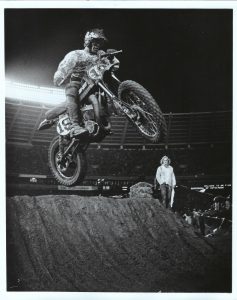
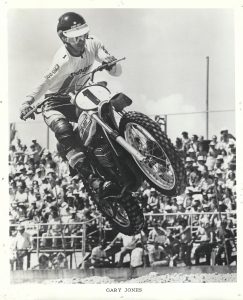
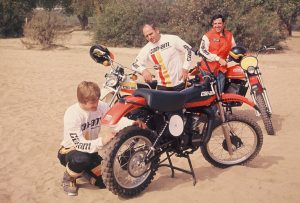
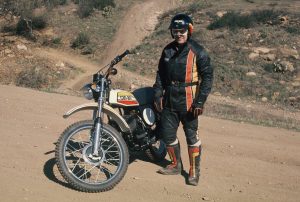
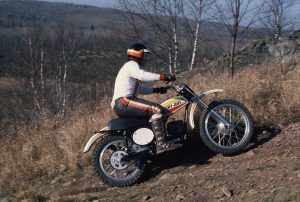
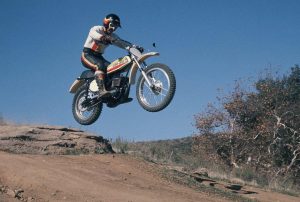
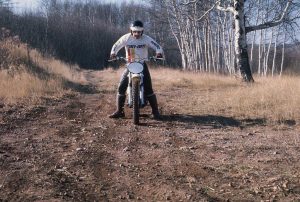
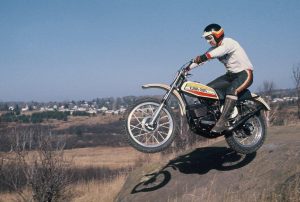
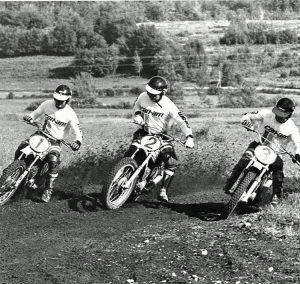
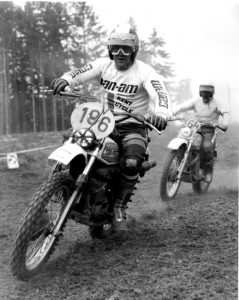
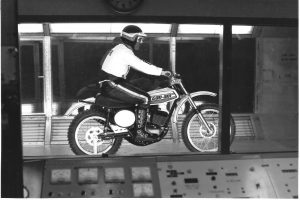
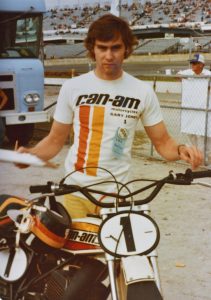
Canada is not a country you normally associate with motorcycles, but in the early 1970’s a then small company, Bombardier (pronounced Bom-bar-dee-ay (or eh! as its Canadian!), launched the MX-1 a 2 stroke motocross bike that in its inaugural year captured gold, silver and bronze medals in 1973 ISDE and 1st 2nd and 3rd in the 1974 AMA motocross championship. The world sat up and suddenly associated Canada with dirt bikes.

In a small sleepy town in French Canada – Valcourt, Quebec – Joseph Armand Bombardier in 1937, had the unique idea of taking a flexible rubber tank type track and attaching a car engine, to create the B7, then the world’s first snowmobile. By 1970, this small company had captured 90% of the worlds snowmobile market and had become a leading manufacturer of recreational products, selling 250,000 snowmobiles in 1969. Bombardier had already developed a successful business by focusing on niche markets. Through the success of their Ski-Doo brand, they had built up a dealership network of over 4,000 in North America, but these same dealers had little to sell in the summer months In an effort to expand the business further, and make use of the recently acquired company Rotax and its existing recreational product dealer network, a decision was made to diversify into motorcycle manufacturing.
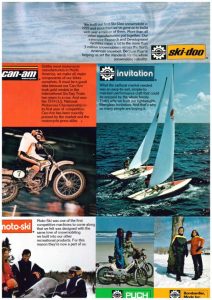
Realising that they could not compete against emerging superiority of the Japanese manufacturers, Bombardier decided to focus on off-road competition bikes, a market in the 1970’s that was mainly being catered for by small European manufacturers.

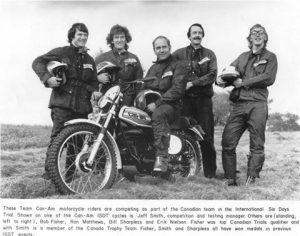
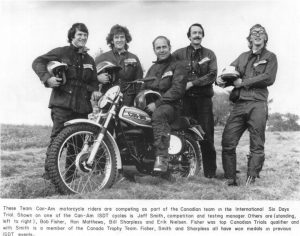
Enter Gary Robison, Bob Fisher and Camille Picard. Gary was the bike designer, Bob an experienced engineering manager, and Francois, a very skilled draftsman. Later on they would be joined by Jeff Smith, the UK based scrambles world champion. No one can criticise Bombardier for not starting with a bang. In Gary and Jeff, Bombardier has secured the skills of one of the leading motorcycle engineers and a two times world motocross champion. Gary Robison was initially christened Vice President and Director of Motorcycle Research and Development, with Laurent Beaudoin, the son in-law of Bombardier founder Joseph-Armand Bombardier, appointed as the leader.

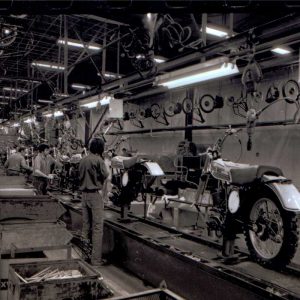
According to Dave McLean, the team given a clean sheet of paper to develop the bike, with the only stipulation that he produced a monthly progress report. Overall they were given a 5 year programme for the bikes. Although the bikes were design from scratched, the concept was to be based on the Bultaco design principal of a standard sized frame that could accommodate a range of different sized engines. This was based on a decision made in 1971 after Bob Fischer and Dave McLean bought every available model of 125 on the market and ran extensive tests. The AJS Stormer gave the concept of stiff backbone to the frame design. The innovative steering head bearing cups, that can be adjusted for different steering head angles, was mainly driven by simplified production on the assembly line.

Other key people include Dave McLean an experienced mechanic and tuner, Scotty Sader as enduro manager, Ken Rosvere as motocross manager and Bob Barker as racing managers. Project managers included, Geoff Burgess, Jim Allen and Ron Matthews. Dick Lague, Robert LeBoeuf and Lars Goodman were marketing/sales directors over the years.

And the name can-am? It was the result of an in house employee competition in Bombardier, based obviously on the anticipated Canadian/ American market. However the name was already synonymous with circuit car racing and required Bombardier to purchase a license for its use.
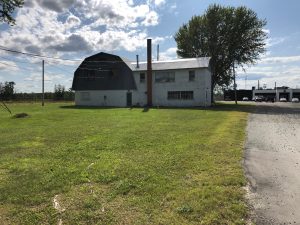
The original can-am headquarters still exists at the Bombardier test facility within the  Circuit Yvon Duhamel and is located a few miles south of Valcourt. The right hand side of the barn were the offices for design and engineering, the left side was for fabrication.
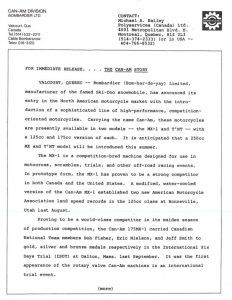


Launch Release

Launch-Press-Release

MCW Release

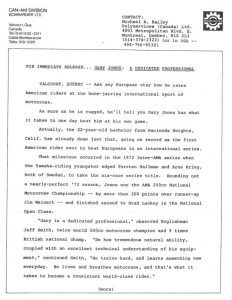
Gary-Jones-Reprint-LR

Gary Jones Press

Gary-Jones-Press-Release1

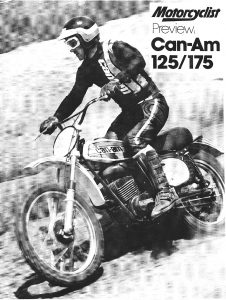
Motorcyclist Preview

Motorcyclist Preview


AMA Release

AMA-Press-Release1

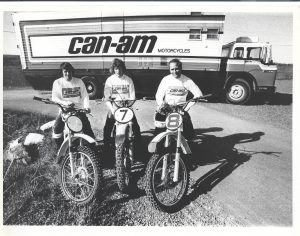
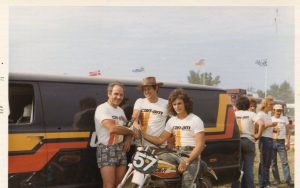
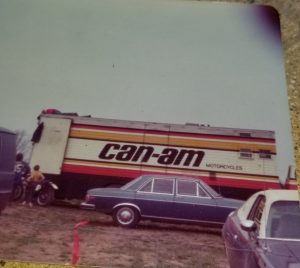
can-am Race Truck
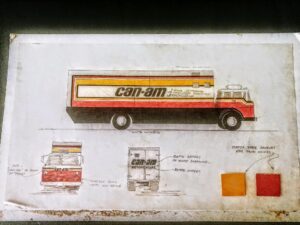


Ever wondered how the can-am race truck came to be? I was recently contacted by someone who gave me the whole story, as it was such a great tale from an original can-am employee, that I decided to publish extracts from emails so it could be told in the writers own words:

My name is Shea and my dad worked for Bombardier West out of Idaho Falls in the late 60’s and early 70’s My dads name was Ray Henrie. He was part of the Can-Am R&D crew for quite a few years and the truck was a project of his. He built out the interior on that rig as well, all I really know is him and a few others travelled around in that truck doing R&D for the bikes. I know he was involved with the sled aspect as well, but not sure the extent.

Sounds like my dad was hired specifically to build that truck from scratch for the Western Research Center, which was run out of Bombardier West in Idaho Falls. Truck was ordered brand new and they had heavy duty suspension installed prior to picking it up. Turns out my dad actually painted and built the truck himself other than hiring a local RV company to build out parts of the living quarters. Rented a paint booth in Idaho Falls to do so and used an overhead projector to stencil all the lettering on the rig. Truck had living quarters in front that slept 6 if needed but sounded like 4 was typical. Had a microwave, a sink, shower, and a toilet. He said they would go out for 2 weeks at a time and live in the boonies to test the bikes. In the rear the truck had a full shop including welders along with anything and everything needed to do repairs in the field.

Truck was designed for a test crew to stress running gear on bikes. They were required to have so many hours on the bikes before they would go into production and they did all of that out of the can-am truck. They had to keep track of location, date & times, specific temperatures, specific terrains, basically all variables involved and record the data. He said they had to do x amount of high-speed miles in the mountains, desert, and even did time at Road Atlanta. They would hire the best local riders to put miles on the bikes everywhere they went along with the riding they did themselves. They tested 125's, 250's, and they were just starting to test the 350's and when they decided to shut down. He said the bikes really performed well and was very surprised at the decision to end the program.

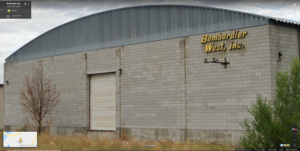
My pops is old and couldn't remember the exact dates or his official title when he worked there, but he said it was the funnest job he ever had. He started in the late 60's and worked there till can-am shut down around 1975. Said he thought his supervisor was Jeff Fisher but wasn't 100% on that detail. Apparently, sales were not high enough to continue. He said they shut down both the Bombardier West and East locations at the same time. I just checked google maps for the Idaho Falls location and the original sign is still on the building 45 years later. I'll attach a few snippets of it. The street was named after the company, so if you look up Bombardier Ave. street in Idaho Falls, Idaho, you can see the location.

My dad also designed and built the sign that was in front of the facility. My name is even written in the concrete at the base. The sign housed Ski Doo, Can Am, and Motoski signs that lit up at night. IIRC, we have pictures of it. If we are able to find it, I will pass it along as well. I have my mom and my sister scouring for old picture. If we are able to get any other memorabilia, I'll be sure and send you copies of it all.

After my initial conversation with my dad yesterday I asked him to call me back if anything else popped into his head. I got another 5-6 calls from him yesterday, which is more than I’ve got this year. So, it was really fun hearing his stories.

Most of the additional calls didn’t yield info you’d be interested in, but it made for a good day for the both of us. However, one call did get a couple of details that could be of some use. I had just read about the 125cc land record at the salt flats on the site and he called within a few minutes to tell me about what it was like to walk barefoot on the flats, lol. I asked if he was out there when that record was set. He couldn’t recall if the record was set that day, but he did mention Bob Barker being out there when he was. Said he was all of a 100 lbs and wouldn’t be surprised if he did set the record that day. Btw, does that record still stand?

I am pleased say Shea that the land speed record record stood for 35 years until it was beaten in 2008.